How can large, complex organizations ensure they receive the best possible return from their investment in innovation? They have to develop a culture of innovation that is driven by their overarching business objectives. This business challenge is becoming more and more critical as the emphasis that companies place on innovation continues to grow, with an increasing number of CEOs citing their support of innovation as critical to their organization’s future growth.
But what is a culture of innovation, and why is an intentional approach to designing such a thing even important? From an anthropological perspective, the phrase “culture of innovation” is collective; it describes the social, material, and psychological environments within which humans innovate. A culture of innovation is what comes from a group of people working together to think beyond their resources and to make new things happen. Taking a human-centered approach to understanding – and subsequently enhancing – a culture of innovation empowers senior business leaders to ground themselves in evidence when launching effective innovation initiatives. To understand their existing culture of innovation, they must ask questions like:
- How do their employees experience innovation?
- What kinds of habits and practices enhance or diminish the range of innovative behaviors that exist across the business?
- Where is the culture of innovation fit for purpose, where isn’t it, and what are the key opportunities to align innovation behaviors with what the organization needs in order to flourish?
Uncovering a Culture of Innovation With Ethnography
To understand different cultures of innovation, it is best to engage the expertise of professionals who specialize in deciphering the distinctive, human-centered nuances that make each organization different: that is, organizational ethnographers. It is within the domain of organizational ethnographers to help C-suites understand their organizations’ current culture of innovation and how it can grow into the future. These experts aim to design new evidencebased programs that actively facilitate the complex network of factors affecting the development of ideas leading to innovation.
Exploring an organization’s culture of innovation, organizational ethnographers investigate things like R&D engineers’ habits and practices; employees’ physical environments; individuals’ and groups’ ingrained values and beliefs; and even the organization’s wider policies, such as incentive structures. Researchers can learn about such factors by observing people, exploring their individual stories, and building out a landscape of their collective experiences. By collating this diverse information, researchers can better understand and articulate an organization’s specific culture of innovation. Addressing these (and other) foundational questions will eventually enable senior leaders within large organizations to make intentional, evidence-based decisions about how they can design an enhanced culture of innovation that is right for them.
We have set out an approach that innovationfocused companies can adopt in order to design an organizational culture that actively facilitates the kind of innovation they need. It highlights the importance of utilizing anthropological expertise in ways that enable organizations to build in-depth understanding around the cultural (and other) factors that affect innovation.
Taking the Plunge
When large organizations decide that innovation will play a leading role in their future, they must begin by making a significant financial commitment to their innovation function. Such investment is frequently followed by the formation of new structures and internal processes intended to facilitate the development of new ideas.
While such a move is undoubtedly important, it needs to be carefully planned and executed in an evidence-based way. Failure to do this properly heightens the risk of ending up with a suboptimal innovation initiative that doesn’t deliver the expected ROI. It is therefore critical for senior leaders, before attempting to design an enhanced culture of innovation, to ask:
How can we build a body of evidence to drive our vision for a culture of innovation that unlocks the greater potential promised by our investment in innovation?
Optimizing a Culture of Innovation: An Anthropological Approach
Taking an anthropological approach to addressing the challenge of how an organization might optimize its culture of innovation involves placing people at the center of study. In practice, this usually means undertaking three key phases of work:
- Mapping the current innovation landscape
- Identifying key opportunities for optimization
- Developing an implementation plan
Ultimately, an anthropological approach to identifying and refining an organization’s culture of innovation is about decoding the cultural and structural workings of that organization; it is about understanding how events, behaviors, and interactions are experienced in people’s everyday reality.
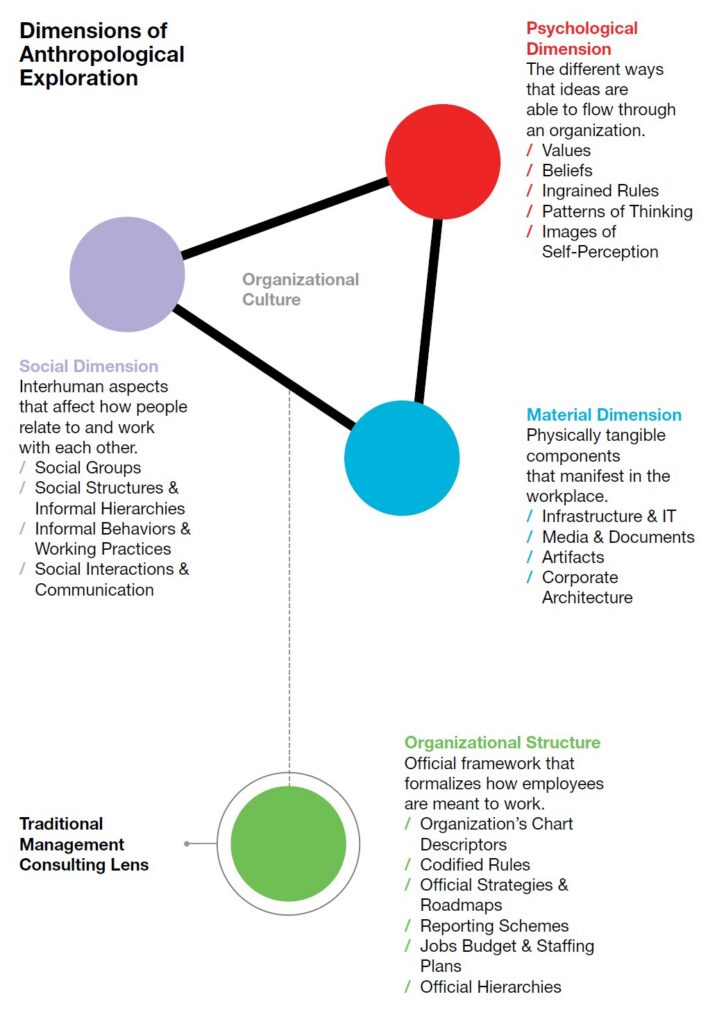
This approach involves looking beyond organizational charts, strategic road maps, formalized processes, and numbers alone. If a company wants to actively facilitate their culture of innovation, it is vital that their leadership understands the company’s culture for what it is: a complex social formation and system of meaning that is largely shaped by people. Organizational ethnographers discover the factors that influence people’s corporate lives within an organization. While employees’ ways of thinking and doing are partly guided by formal rules, official strategies, processes, and hierarchies, the day-to-day activities of an organization come from a host of informal behaviors, beliefs, values, and patterns of communication. These data points are evaluated according to the following robust conceptual framework:
Phase 1: Map the Current Innovation Landscape
In order to map the innovation landscape of an organization, the interrelated dimensions of the organization’s culture – from its people to its formal structures – must be explored. To do this, organizational ethnographers immerse themselves in the spaces and places where employees engage and experience their (working) lives. Such an approach typically includes a set of rigorous and well-established anthropological methods.
These include:
- Observing employees’ daily lives inside the organization over a period of weeks
- Shadowing individual employees in key roles in order to explore their working practices, routines, interactions, and typical behaviors
- Engaging in informal office floor conversations, including ad hoc water cooler conversations, to capture off-the-record views and anecdotes about the company
- Completing semi-structured one-on-one and group interviews with a broad variety of organization members across different units, sites, and levels
- Conducting expert interviews with key stakeholders and decision makers to learn about previous strategies and their implementation
- Analyzing documents and media detailing HR and internal communication strategies, onboarding materials, intranet content, and internal communiqués to capture the “official” story an organization tells about itself
The ethnographers then collate and analyze the data collected in this initial phase in order to develop deep human insights that highlight the key factors that affect an organization’s culture of innovation.
Phase 2: Identify Key Opportunities for Enhancing a Culture of Innovation
Phase 2 leverages the insights captured and developed in Phase 1 in order to identify key opportunities for enhancing a culture of innovation. The insights drawn from an organization’s culture of innovation drive the development of key opportunities for enhancement. Such opportunity areas could include people’s attitudes toward trust, risk, or even their relationship with failure.
Each opportunity area is developed a step further in order to uncover what trust, risk, and failure mean from the perspectives of individuals, teams, the organization, and even the sector as a whole. The key outcome from this phase is a suite of prioritized opportunities for enhancing a culture of innovation.
Phase 3: Develop an Implementation Plan
Finally, each of the prioritized opportunity areas needs to be developed into actionable, evidence-based implementation plans designed in ways that will matter to people. Importantly, a successful implementation plan will involve the fusion of three key elements:
- Human insights that express the cultural factors affecting an organization’s ability to innovate
- An organization’s core business objectives, as well as its wider vision
- Industry expertise into the best practices associated with the active facilitation of innovation processes.
So What?
It is a mistake to assume that every organization needs the same kind of innovation. More innovation isn’t always better, nor is it necessarily what an organization needs in order to succeed. Furthermore, it is equally wrong to automatically parachute one organization’s bespoke strategy for enhancing its culture of innovation into another – when it comes to innovation, one size does not fit all.
However, if you are part of an organization that relies on the sustained output of an innovative community of employees, it is a bigger mistake – and perhaps even negligent – to overlook the factors that affect how your organization develops ideas (i.e. how it innovates). Instead, it is through understanding the foundational landscape of innovation within an organization that a company’s C-Suite can assert their active facilitation of the kind of innovation that aligns with their business needs. This, for example, could mean developing pioneering incentive structures, devising new project funding mechanisms, or establishing more emotive communication structures.
Whatever the eventual outcome, the anthropological approach to understanding innovation enables an organization to make key decisions for enhancing its culture of innovation based on evidence. To design successful enhancements of a culture of innovation, an organization’s leaders must understand how people actually innovate within it – as opposed to how they might like them to.